“Robin Hood” is No More, But His “Merry Men” Live On…Maybe

Oliver Queen adjusts to his new role as The Spectre

Almost nine and a half years ago, I wrote my thoughts here on the CW’s Arrow just before the second episode aired. At the time, I was cautiously optimistic. Keep in mind that Smallville had just ended after a 10 season run. Rather than create a spin-off with the Green Arrow that had already spent numerous seasons on that series, executives decided to create a brand new series starting up a whole new universe in the process. An……Arrowverse, if you will. But we didn’t know that at the time. Did anyone have this plan from the beginning? It’s hard to tell. As with Smallville, there were many hints toward a bigger world that was out there. However, there was one correction made behind the scenes of Arrow that was done way too late in SmallvilleArrow heavily leaned into their comic origins way sooner. Smallville often hinted at its comic origins, but arguably didn’t really take a full step in that direction until the appearance of Bart Allen, or Impulse, in the fourth season. Arrow, on the other hand, had star Stephen Amell wearing a costume within the first few episodes and introduced (as well as gave powers to) Barry Allen in the second season. Once the new Flash series was confirmed, I realized the possibilities that having a Flash could bring in not only introducing new characters, but connecting other universes (series/movies) to the budding Arrowverse as well. This was proven when The Flash and Supergirl announced that a crossover was in the works and since by this time I had started up a YouTube channel, I quickly put out a video announcing the multiple speculations that had been permeating in my head.

…and then Black people all over the country cheered

Even though by that time, Supergirl, Legends of Tomorrow, The Flash, and Arrow had already begun airing, I could not have imagined how much bigger this universe would get. Since then, these heroes have joined forces multiple times, and increased their forces, now including Batwoman, and Black Lightning. Though unfortunately, the celebration seems a bit premature as Black Lightning and Supergirl are both in their final seasons and a new Batwoman has taken the mantle just after the Justice League was formed. And with this, we must get to the meat of this post – the departure of Stephen Amell’s Oliver Queen. The eighth season was the final for Arrow, and as such, the CW gave him a goodbye worthy enough to solidify his Green Arrow as the television version of Robert Downey Jr’s Iron Man. The final season was an abbreviated one that had Oliver tying up loose ends before preparing for the most ambitious television crossover of all time: a five-part CW adaptation of the 1980s DC story, Crisis on Infinite Earths. As such, it involved every DC property ever created, including cameos of reprised characters seen in earlier DC media, such as Dick Grayson/Robin (1966’s Batman), Alexander Knox (1989’s Batman), Hawk & Robin (Titans), Clark Kent & Lois Lane-Kent (Smallville), Helena Wayne/Huntress (2003’s Birds of Prey), Lucifer (Fox/Netflix’s Lucifer), Barry Allen/The Flash (1990’s The Flash), and even featured a special scene where the DCEU’s Barry Allen meets the CW’s Barry Allen. At the end, much like the original comic version(s) of the Crisis, all of the CW’s comic-based series are confirmed to be within the same universe, while others, such as Swamp Thing, Titans, and Doom Patrol are all in their own separate universes.

Barry Allen, meet Barry Allen

So even though celebration may be premature, I still look forward to what DC and the CW have in store for us. So far, the only new series that is taking the place of an old one seems to be Superman & Lois, with Teen Wolf‘s Tyler Hoechlin and Grimm‘s Bitsy Tulloch reprising their respective roles as Clark Kent/Superman and Lois Lane. I haven’t brought this up because I personally don’t think it matters, but Marvel seems to have all sorts of plans and counterplans and contingencies for their broadcasting future. As DC seems hellbent on keeping up with Marvel in this area, it would seem likely that there’s someone trying to cook up plans to keep themselves relevant. Whether or not their films have been up to snuff is debatable, but television is the one area where DC has dominated over Marvel for at least the past decade or so. It would be a shame to see them go out with a whimper due to something they could have prevented.

Ads – What ARE They Good For?

Mmmmm, just like candy!

Let’s talk about ads for a moment. I know – everyone’s favorite part of watching television. Personally, I do like ads. It’s what I’m most interested in seeing during the Super Bo – sorry, the “Big Game” and why I try to get to the movie theater on time. But I would like to specifically focus on video game ads. What exactly makes a good ad? Well, in the name of capitalism, a “good” ad is one that gets a viewer interested in using the product being advertised.

Traditionally, advertisements would simply talk about the product and its features. Literally. I think most of us have seen Lucille Ball slur her way through the Vitameatavegemin episode doing exactly this. However, in modern times, advertisers have to be cleverer. Many present day ads focus on making viewers feel a certain way and then connect that feeling to their product. One of the best examples of this is the Japanese ad for the game, Dragon Ball Z: Kakarot. The premise of that game is that you play through the entire plotline of the animated series, Dragon Ball Z from the perspective of different characters. The ad follows a man coming home from work. On the way, he passes kids pretending to be characters from the series. When he gets home, he opens the game and begins to play. As he does, he’s flooded with nostalgic memories of himself and his childhood friends enjoying different events throughout the series, which causes him to shout along with the characters in excitement. Cut to another scene of him walking home again, proudly admiring the kids again pretending to be the same characters he grew up loving. It’s really an amazing ad, and despite the whole thing being in Japanese, hundreds of comments on the video say that they didn’t need to understand Japanese to know what was happening because that was them. And then I think of the ad for the game, Black (PS2/Xbox 360), which is just a room getting shot, followed by a gun shooting. Why do I want that? What’s the premise? The only reason I even remember the ad for it is because of how annoyed I was at the lack of creativity for it.

“We are all Son Goku,” indeed

That isn’t to say that only games with a built-in fanbase have good ads. The original ad for the NES game, Paperboy, was a classic, where the main character is mischievously tossing papers into people’s windows while dodging obstacles and eventually gets chased by an old lady (which was all from the game). Likewise for the original SOCOM U.S. Navy Seals ad. I wasn’t interested in the game at all until I saw the ad for it. It shows four guys playing together online (which was brand new for the time) and they’re getting killed one by one, quickly. As they do, they all get frustrated since they can’t see their opponent, and the last one to get killed rips off his headset, asking, “Who are these guys?” Cut to a tent in the Middle East, where a soldier wearing a headset high fives his friends and confidently states, “like shooting fish in a bucket.” I couldn’t say exactly what got me in that moment, but the moment I saw that ad, I knew I needed to play that game. Heck, I don’t even really like challenges like that. Upon first seeing the Daigo Parry, I put down Street Fighter III, never to play it again. Unfortunately, as a poor college student, it would take me many, many years to actually own it. Another example is the original ad for Nintendo 64’s Super Smash Brothers, which features a number of mascoted Nintendo characters frolicking in a field of flowers until Mario trips Yoshi, leading to a brawl.

No, really – who ARE those guys?!

That said, when it comes to franchise ads, the Japanese have a tradition of crushing it. Somehow, they’ve been able to read exactly what a fan is interested in seeing, and put that right into the ad. And to be honest, they aren’t generally all that creative, but there is a certain excitement that comes with seeing their ads because of some parts of them. One of my favorite staples of Japanese game ads is the character profile. This is a point during the advertisement when familiar characters are shown, along with a brief demonstration of their skill set and a catchphrase. These are particularly found in crossover game ads such as Tatsunoko vs Capcom, Sunday vs Magazine, Dynasty Warriors: Gundam, or Final Fantasy: Dissidia.

Uncharted‘s Nathan Drake talks to Final Fantasy XII‘s Lightning about his adventures with “Michael.”

In present day, it’s far less likely to see ads for a specific game anymore unless the game comes from a mega-popular franchise. Even then, sometimes, much effort isn’t necessarily put into it. Many of the most creative modern ads are those swaying a person towards one console or the other – for example, one of the greatest examples was some years back, when Sony featured a mysterious ad during the Supe — (almost did it again) “Big Game,” where a World War 2 paratrooper lands in woods, and goes to a secret bar, where we find people like Lightning (Final Fantasy XII), 47 (Hitman series), Sweet Tooth (Twisted Metal series), Chell (Portal series), Sackboy (LittleBigPlanet series), Ratchet (Ratchet & Clank series), Paul Phoenix (Tekken series), Ezio Auditore (Assassin’s Creed II), and Kratos (God of War series) among others. We start to hear testimonials of life harrowing experiences from different characters, like Nathan Drake (Uncharted series), Cole (InFamous series), and Snake (Metal Gear Solid series), until our soldier speaks his mind and dedicates his survival to “Michael.” A portrait of “Michael” holding his controller is shown as everyone raises their glasses in tribute, and we start to see the bar’s ceiling is full of portraits of countless other people we now realize are gamers. Truly a beautiful ad. I, for one, hope creativity like this never truly goes away. While I recognize what ads are there for and the pull they might have, it is still fun to see how they might try to sway us. Why else is the “Big Game” such a draw for so many people? When it’s that time of year, a significant amount of people seem to tune in purely for the big ads that premiere during this time. In a recent turn of events, one car company even spent millions to recreate one of the most famous video game exploits of our society. In the early 1990s, the premiere sports game for the Nintendo Entertainment System was a game called, Tecmo Super Bowl, sequel to Tecmo Bowl. It was the first game franchise officially licensed by the NFL, meaning you could play as real players. By today’s standards, it was fairly simplistic, featuring only 8 plays per team. If the defense picked the same play as the offense, it led to the entire defensive squad overwhelming the offense. However, there were a few legends in the game that made winning extremely easy. The San Francisco duo of Joe Montana and Jerry Rice, the Detroit Lions’s running ace, Barry Sanders, but most of all, the LA Raiders’s Bo Jackson. With Bo Jackson, one could run from end to end back and forth, and relatively easily shake or break tackles (technically, it’s also possible with Barry Sanders, but it’s slightly more difficult). In 2017, for the “Big Game,” Kia aired a commercial featuring an 8-bit Bo Jackson who runs out of the stadium and uses a Kia Sorento to show off his famous agility and score a touchdown. So while it wasn’t exactly a video game ad, it did use a video game for the ad as well as reintroduce the game for a new generation. Which somehow leads us back to Dragonball Z: Kakarot. Ah, who am I kidding? I just really like ads and I don’t want to necessarily want to see them go away.

A personal favorite: Nintendo’s “Settle It In Smash” campaign

The Persistent Lie of Live Action Adaptations

Mortal Kombat exists. Again. Yes, I realize the games have existed in the ether on a semi-regular basis since the early 1990s, but I refer to the movie. This is the third live action Mortal Kombat film to see release after a 1995 counterpart and its sequel, Annihilation. Based on trailer reactions, the hype was absolutely real. However, the full film received much disappointment. What did I think of it? Well, I haven’t seen it yet. That said, I won’t go in with high expectations. After all, it is Mortal Kombat. Since its original creation, the MK storyline has been through all sorts of convoluted ups and downs, switching from Bruce Lee expy Liu Kang as the original protagonist to what seems to be the lightning god Raiden in modern day iterations. The most recent game in the franchise, Mortal Kombat 11 even added time travel to include past versions of characters within the game. But all in all, Mortal Kombat is still Mortal Kombat. The game revolves around an otherworldly tournament to the death (even though many character return). If it has characters, movesets, and a plot fitting the game, I’ll be pretty satisfied overall.

Dean Winchester drops a hard truth in Supernatural.

Generally, when the topic of live action adaptations, particularly movies, come up, the responses among the average populace are usually the same – complaints that they’re never good, snide remarks about the actors, and all sorts of grumbling in general. However, these comments mostly come from people who already don’t want an adaptation to be made. Their minds are closed to the possibility of enjoying the film to be made, and as such will find reasons to hate it before it has even begun filming. When asked, if they have ever seen an adaptation, it is one that was likely a well-known title and quite difficult to adapt. Primary examples of this are Dragon Ball Evolution and Doom. However, contrary to what your average casual fan might like to proclaim, there have been many good adaptations made of properties. Of course, for this purpose, we’re not going to be referring to standard books. It’s common knowledge that despite flops like the Percy Jackson series, The Golden Compass, and Mortal Engines, books make for very good adaptations as evidenced by Jurassic Park, and the Harry Potter & James Bond franchises. But if anyone were to ask about video game or anime adaptations, they would get a vastly different answer. “Why are they trying again,” would be the cry from so-called fans. “They NEVER get it right!” Au contraire.

Let’s take a look at the history of anime & video game adaptations. The earliest live action video game adaptation was Super Mario Bros. in 1993, and the first anime adaptation was Fūryū Kokkei-tan: Sennin Buraku (“Hermit Village”) in 1961. And hoo boy, I’m certainly not going to deny that SMB wasn’t terrible. As a child who loved both movies and video games, it was the first time I ever left a movie theater feeling utterly disappointed. However, from there, things certainly got better. Fortunately, I never saw Double Dragon in theaters, or I would have probably been angry at that, too. But I did see Street Fighter. And while it wasn’t great, it certainly was enjoyable. Mortal Kombat was next, and I liked it better than Street Fighter. But one of the best was yet to come. While I don’t recall the exact when I saw Lara Croft: Tomb Raider, I know I saw it in theaters and I came in cautiously optimistic of American Angelina Jolie properly portraying the UK-born Lara Croft despite having the look of the character, and was blown away. It was at that point I knew live action adaptations could be done well.

Emile Hirsch adopts Speed Racer’s signature pose

It would be a few years later that I would see my first live action adaptation of anime. I had seen adaptations of cartoons that I had enjoyed, such as The Flintstones, Inspector Gadget, and Masters of the Universe. But Cutie Honey would be the first adaptation of anime that I saw, beginning my craving for more live action adaptations. It was especially this scene from Casshern that helped push that desire. And then came 2008. Speed Racer, the very first big budget live action adaptation of anime from Hollywood was released and it was absolutely glorious. But unfortunately, no one cared at the time, citing unknown perceived doubts of previous straight-to-DVD films, causing an amazing movie to flop. Since then, Speed Racer has gained some popularity, and is considered by many to be one of the most underrated films. I personally consider it to be my favorite live action adaptation of all time, just barely edging out Rurouni Kenshin 2: Kyoto Inferno. But the very next year came one of the worst adaptations: the aforementioned Dragon Ball Evolution. Many fans complained about the direction that was taken in the film to deviate it so far from the source material, but my perspective on this is that they have no one to blame but themselves.

When you really look at the problems of DBE, one of the most glaring issues is the fact that it came from 20th Century FOX. 20th Century FOX, for those not in the know, has a long history of a trope known as “executive meddling.” Executive meddling is when studio heads don’t like the way something looks and use their weight to change things. Sometimes good things come from this, but some of the worst changes are known to come from this as well. One of the most famous examples is a Kevin Smith story from when he was hired to write a Nicholas Cage Superman movie, and a producer insisted on changing Superman’s powers and having him fight a giant spider (which was parodied in the animated film Superman: Doomsday). The giant spider would apparently go on to make its appearance in Wild Wild West. But, yes, 20th Century FOX is quite known for sending representatives to filming locations and micromanaging details. However, since Speed Racer had just flopped despite Warner Brothers giving the Wachowskis complete creative freedom on the film, who could blame them for protecting their investment this time around? I’m usually the first one to take a pitchfork to FOX for their meddling, but in this case, I can see why they might’ve done this. So…yeah.

Gohan fends off Androids 17 & 18 in the fan film DBZ: Light of Hope

As of today, despite the massive griping fans do over anime-based live action adaptations, there have only been six serious attempts from Hollywood: Speed Racer, Dragonball Evolution, Edge of Tomorrow, Ghost in the Shell, Death Note, and Alita: Battle Angel. At least four more have been direct to DVD: The Guyver I & II, Fist of the North Star, and Kite. The Guyver is the oldest of these, being from 1991. On the other hand, there are countless movies in Japan with origins from anime. Unlike all of the franchises Hollywood has picked, the vast majority of these have fairly practical settings. For example, the title which currently holds #4 of my favorite anime adaptations is the Japanese movie Bakuman, a series about high school students who want to make comics. Right after that on my list is Hoshi Mamoru Inu (“Star Watching Dog”), which follows a government official as he traces the origins of the corpses of a homeless man and his dog to notify their family of their fates. Not to say that all attempts of fantastical anime adaptations can’t be done. As I mentioned before, Speed Racer is my favorite adaptation. And beyond all my expectations, Robert Rodriguez’s Alita: Battle Angel replaced Bakuman in my #3 spot. What’s great about present day filmmaking is that great adaptations no longer solely come from big budget studios. On Youtube, fan-created films such as Robot Underdog’s Dragon Ball Z: Light of Hope and Rivenx3i’s Naruto Shippuuden: Dreamers Fight have garnered millions of views and rave reviews worldwide.

Michael Fassbender prepares to take Assassin’s Creed‘s signature “Leap of Faith”

And so we go back to video games. Can the same kind of success be replicated in this medium? I’d say yes. However, the staunch expectation — nay, insistence that adaptations be terrible despite the effort put into them perpetuates this sort of thinking. Even highly successful films like Pokemon: Detective Pikachu and Sonic the Hedgehog see detractors regularly asking over a year later if they were good enough to bother seeing despite the rave reviews and accolades they received. However, it would help studios if they took a page from their Japanese counterparts and perhaps start with games that are more practical to adapt. The Tomb Raider movies are great examples of where to begin and MCU Spider-Man, Tom Holland, has already been tapped to play the film version of Uncharted protagonist Nathan Drake. Despite the hate that they received, the Assassin’s Creed and Hitman films were also fairly faithful and made for interesting entries in the franchise. And even though the films went in a much different direction than the games, the Resident Evil film series has developed a level of popularity for simply being interesting while maintaining some ties to the original games. The good movies are there if you want to see them. Just keep your mind open and stay far, FAR away from the King of Fighters and Fist of the North Star movies.

A Salute to an Almost 10 Year Commitment to “The Last Frontier”

As far back as I can remember, I always wanted to travel the stars.

I credit that latent desire on Star Trek: The Animated Series, which originally aired in the 1970s, but was rerun in the early days of Nickelodeon in the 80s – long before they would begin to create their own popular shows, such as Clarissa Explains It All, Eureka’s Castle, or even Double Dare. While I was introduced to Gene Roddenberry’s utopian vision through the animated continuation of the canceled live action television series, that love would eventually spread throughout the entire franchise. Whether or not it was truly the second movie I saw in a movie theater, I clearly recall the excitement of going to the Cineplex Odeon in New Jersey’s Woodbridge Mall to see Captain Kirk finally make peace with his rival Klingons in Star Trek VI: The Undiscovered Country. Today, I happily gobble up new Trek media, but that wasn’t always the case. At that time, I was quite protective of my Trek, not even accepting The Next Generation until late in its run. I would have a similar disdain for Deep Space Nine, but this time because it “only took place on a space station, not a ship.” Looking back now, that kind of attitude doesn’t accurately reflect the true spirit of Trek and I regret that behavior.

Anyway, back to the point – I have a long history with the Star Trek franchise, which does include games. One of the earliest Star Trek games I can remember playing was on PC in the late 80s. One of my mother’s coworkers would allow me to use his work station to play some sort of Star Trek game that was incredibly basic by today’s standards. The player was the Enterprise and would explore space and fight enemies of the Federation. Unfortunately, I no longer know the name of this game for sure, but I believe it was a DOS game called, Video Trek 88, that was originally released in 1982. However, the most memorable game in this franchise for me (even up to today) was a different game my mother bought me as a teenager: Star Trek: The Next Generation – A Final Unity.

A Final Unity was a 1995 PC game that sent the crew of the Enterprise-D on an archaeology hunt for artifacts from a game-exclusive ancient race called the Chodak. What made this game so unique was not just the fact that it played just like an episode from the series, but that it was incredibly organic. The plot points were fairly linear, but there were multiple ways to get to the endings. Not only that, but it was relatively open world. This meant that players were allowed to travel more or less wherever they desired to go. Upon this realization, as a kid Trekker (Trek fan), the very first course I had my helmsman set was to Sector 0-0-1. For those who aren’t familiar with Star Trek coordinates, Sector 0-0-1 is where the Sol system is located (or in further layman’s terms: Earth). So imagine my disappointment when our home planet wasn’t where it was supposed to be. As a child, I was quite disappointed, but now I realize that there possibly simply wasn’t enough space as the game was pretty large for its time. So, I instead set course for the Romulan homeworld, since the Romulans had a significant presence within the game. As expected, almost as soon as I crossed the Neutral Zone (a DMZ), I would get embroiled in battle and destroyed.

Speaking of battle, it wasn’t anything much to write home about with the ships appearing to just make random circles, no matter which evasive maneuvers were attempted. However, everything else was incredible. Players were able to adjust their power input and output in Engineering, visit various parts of the ship, and even select which senior officers to take on away missions. And this is where the game really shined. On away missions, each character had special talents. Without Dr. Crusher, if you encountered an injured person, you couldn’t help them. Data and Worf were incredibly strong. Geordi could assess and fix any structural problems. Captain Picard was authoritative and knew archaeology, and Counselor Troi could read people, inducing more desired responses. There was even a matriarchal race in the game that only responded positively to female characters. Today, A Final Unity is still considered one of the best Star Trek games ever created.

Unfortunately, as I mentioned before, A Final Unity was created in 1995. It was technologically advanced when it came out, but quickly became obsolete, so by the mid 2000s, I was completely unable to play it. For years, I hungered for a new Star Trek game that could bring me the same kind of joy that AFU provided me. And nothing came close. Not until I discovered Star Trek Online in 2011.

To be honest, I knew of STO before 2011. I’d been interested in trying it since it first became available in 2009, but those were still the days when MMORPGs (Massively Multiplayer Online Role-Playing Games), such as City of Heroes and World of Warcraft required paid monthly subscriptions. I was poor. I couldn’t guarantee being able to pay any sort of regular fees. But MMOs were beginning to drop their monthly costs and in 2011, STO did exactly that, allowing me to finally jump in without worrying about costs. As I would soon learn, just because the game itself was now free, doesn’t mean that I can get most of the recognizable things I loved from the franchise without paying. And so began my habit of so-called “careful payments,” where I would check my wallet and spend on rare items. But as I stated before, I was poor. Eventually, my original account was banned for charging and acquiring items I couldn’t afford to pay for.

How exactly did that happen? Weird bank stuff. I don’t recommend being poor if you can help it. Particularly if you like having things.

Sonequa Martin-Green (ST: Discovery) and Jeri Ryan (ST: Voyager/ST: Picard) reprise their characters, Commander Michael Burnham & Seven of Nine, in a recent STO expansion.

Therefore, I immediately made a new account and this is how I’ve accessed it since. As such, I’ve been playing STO off and on for approximately almost 10 years. The intermittent status is mostly due to lack of internet access, since I lived in rural Grand Canyon, AZ for most of that time. There is a major benefit from being away from it so long though – the differences between when I first began and my consistent return last year are far more apparent than to someone who might have played during that entire time.

The most obvious difference lies in the sheer variety of characters that are available. Originally, when the game was fairly new, There were only two, maybe three factions that were available: the Federation of the present (30 years after Nemesis), the Federation of the past (The Original Series), and the Klingon Empire. Each faction had a few races available, with the present Federation offering the most. Now, factions have grown to include the new Romulan Republic (Star Trek), the Dominion (DS9), and the updated past Federation (Discovery). There are extra races available as both playable and non-playable characters for pay. My own personal list of characters consist of a Talaxian (a race exclusive to Voyager) man and Orion woman in the Klingon Empire, a human man and Cardassian (a race mostly seen in DS9) woman in the present Federation, a Romulan ex-Borg woman in the Romulan Republic, and a Vulcan woman in the TOS Federation.

Another quite noticeable difference is one that just happened weeks ago – starships that were exclusive to certain factions are no longer exclusive. At this time, it simply requires someone to have a character within the Klingon faction that is at the maximum level. This perk is retroactive, as well, meaning if someone already had met that prerequisite, then all of the characters on their account would be able to use ships of any faction. While the gates are wide open right now, this was something that had been hinted as being in the works. Before this revelation, the developers had been releasing cross-faction ships for months in the name of some of the factions secretly working together.

Lt. Commander Data plays poker with holograms of intellectual titans Sir Isaac Newton, Albert Einstein, and Dr. Stephen Hawking in the Holodeck (ST:TNG)

One of the really fun things I find about this game are the ways that the game uses established Trek lore to create new features. When STO was still new, the creators banked on bringing in familiar characters to help bolster popularity by having the actual actors reprise their original roles. In fact, Leonard Nimoy was the original spokesman when the game premiered. His voice remains in the game to this day as an introductory narrator of sorts. While this still definitely happens, they’ve found other ways to tap into potential consumers’ nostalgia. A great way this has been done is with the releases of “holographic bridge teams,” where players can go on away teams with some of their favorite characters. See, The Next Generation popularized the concept of fully immersive, interactive holograms that can be designed to look, feel, and sound like anything or anyone. However, they could not leave the particular room where the projectors were, or they’d be instantly deleted. Voyager kept this concept when they included a main character who was a hologram, and as such, was unable to leave the infirmary, where his projectors were. That is, until they came across a personal-sized projector from the future that allowed him to go anywhere he liked. I personally like the the idea of the Federation being able to duplicate the Doctor’s mobile emitter for personal use. In actuality, it’d probably be chaotic, but for a game, it’s a fun concept.

The Doctor admires his new mobile emitter (ST: Voyager)

Growing up as a Trekker, this game hits my buttons in exactly the right ways I need it to. Is it perfect? No, not at all. I’m not a fan of essentially being left to either gamble or drop big bucks (which in some ways is the same thing) for some things, but I can be impatient and don’t have a lot of luck when it comes to random pickups. However, it does quench my thirst for more Trek whenever I’m craving it. I love being able to explore the galaxy in the ships that I always wanted to have adventures in. It’s no wonder that this is the single game that I’ve spent the most time on in my life. According to Steam, I’ve logged about 1,100 hours, or approximately 1 1/2 months nonstop since 2014, when I linked my game account to the platform. I can go to the places I only imagined visiting, in a ship that I wish I owned, and meet the people I’ve spent most of my life admiring. Star Trek Online is in its 11th year of availability, and with the new expansions as well as its port to PlayStation and Xbox a few years back, it’s showing no signs of stopping. After all, War of Warcraft is at least five years older, and it’s going strong. Star Trek Online already had the backing of a fanbase that continually grows. Discovery will begin filming its fourth season soon. The second season of Picard should be arriving shortly. Lower Decks just finished a triumphant first season. Strange New Worlds, a spin-off of Discovery, is currently filming. And the will-it-won’t-it question of a Star Trek: Beyond sequel seems to be landing on “it will.” I, for one, am looking forward to another 10 years of STO. What will it possibly bring?

The Age of Wushu – China’s #1 Anticipated MMO Comes to America

While there have been many video games that delve into Japanese culture, there have been very few that really get into specifics on Chinese culture. In fact, outside of the Dynasty Warriors series (which are based on the legendary Chinese story, Romance of the Three Kingdoms), you’re hard pressed to find a game that reflects on what has been one of the longest, richest cultures in the world. There’s been the official Crouching Tiger, Hidden Dragon game, but beyond that, not much else. Most other games that go into Chinese culture tend to use a modern-day setting, like True Crimes: Streets of LA, Wu-Tang: Shaolin StyleStrangleholdJackie Chan Adventures, and Rise to Honor. That’s where Snail Games comes into play.

Snail Games are a small United States division of Chinese developer Suzhou Snail Electronic Company, Ltd, who focuses primarily on online gaming. While the US division hasn’t been around too long, the main company has been in business for just over a decade. Despite this, they hit the ground running, winning the “China Cultural Games Overseas Development Award” 4 years in a row, “China Top 10 Game Provider” 3 years in a row, and 30 other awards from various outlets including government, media, industry, and player communities worldwide. Despite this, Snail’s biggest endeavor is yet to come.

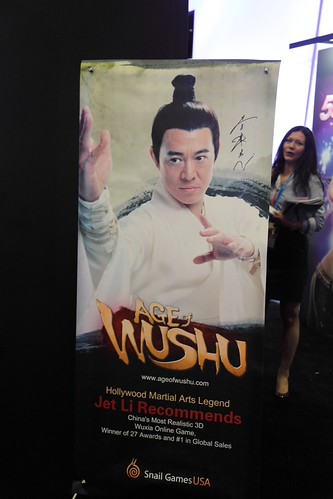
Jet Li for Age of Wushu

Age of Wushu (or Age of Wulin, as it’s known in Europe) is quickly becoming Snail’s biggest title yet. Already one of the highest ranking games in China, it is also only the second original game to secure a celebrity endorsement from a famed Chinese martial artist: Jet Li, who also endorsed and starred in the Playstation 2 cult classic, Rise to Honor (True Crimes was endorsed by Snoop Dogg, Wu-Tang by the Wu-Tang Clan, and StrangleholdJackie Chan Adventures were based on a movie & tv series respectively). What makes it so interesting? Well for one thing, as the title suggests, it focuses on actual martial arts rather than a hack n’ slash style of combat. In other words, like many single-player games have implemented, there is a system for actively using dodging & parrying techniques rather than rolling the dice as it were and hoping the opponent misses. Another is something of a revolutionary idea in MMOs: your character does not level. Instead, as it has been seen in single-player games, skills will level. From jumping to dodging, to weapon proficiency, the more your character does an action, the better they will get at it. Not only that, but many of your character’s skills can be customized as well.

Another difference between this & many MMOs is the fact that there are no classes. In their place are 8 schools including Wu-Tang (or Wudang), Shaolin, Royal Guard, and Emei. As with reality, while your character may primarily know techniques from their initial school, they can go to another school and learn skills from there. However, there may be times when learning a skill from a different school would be counter-productive for your character, such as a Shaolin-based character (who value their bodies as temples) learning Drunken-Fist skills (which as the name states, requires the character to be drunk for maximum effectiveness). The result would be self-destructive moves which would liken any battle to that of Krillin vs Perfect Cell. In true martial arts fashion, there are a myriad of weapons to choose from, such as bare-hand, single-blade, dual-wielding, daggers, hidden weapons, throwing knives, staffs, bladed staffs, and many more. On the other hand, like many modern MMOs, there are professions which characters can learn in order to make in-game money or items. Some of these include beggar, scholar, royal guard, and fortune teller. And in true “my kung fu is stronger than yours” form, you will be able to challenge your profession skills against other players. This is in addition to combat-based PVP tournaments which will be held regularly and random challenges which can be made at any time.

And what of the missions themselves? Age of Wushu, like the RPG game Dragon Age: Origins, will feature a main storyline mission that will vary depending on what your character’s background and hometown are. And much like many RPG games, there be a large number of side quests. To gain access to some side quests, your character will have to have certain relationships with NPCs, usually some level of trust. An extra interesting feature this game will have is that while the player is logged off, they will have the option of leaving their character still in the game doing some sort of autopilot activity including working at a shop for in-game cash. As with an MMO, one could imagine that there a risk involved with taking this option, and there is. Malevolent players will be able to kidnap these characters and sell them into slavery, so that instead of logging back in with a surplus of money, they will have to buy their freedom before being able to go anywhere. But do not fret – kidnappers will be easily identified by a special icon over their heads and a large sack on their backs while they are in the process of doing so and do-gooders will be able to foil their plans through a battle.

Age of Wushu looks to be a fresh, exciting change to the MMO genre. The world of ancient China has captivated much of the world’s population for decades. Now, for the first time, fans of China and the martial arts will get a chance to join that world. As with all of Snail’s games, this will be 100% free to play, however, there will be an online store for special items and gear as well as the opportunity to preorder the game with special items & bonuses for just $9.99. Age of Wushu is currently in its first Western beta test and will start up a second beta in December before its official release in February of 2013. See more about it at http://www.ageofwushu.com.

The New Adventures of “Robin Hood”

Green Arrow (Stephen Amell) joins the ranks of DC characters with their own titles, such as Plastic Man, Wonder Woman (Lynda Carter), Captain Marvel (Jackson Bostwick), The Flash (John W. Shipp), Steel (Shaquille O’Neal), and Static

As I’m preparing to watch the second episode of the brand new CW series, Arrow, I find myself bristling with excitement about it. Is it because it’s another highly anticipated presentation of the superhero world? Eh, not really. I have SyFy’s Alphas for that. I’d have to say it’s because this is a bit of new ground for DC. After all, it is VERY rare that they depart from anything involving Batman or Superman – especially when it comes to live action. When compared to Marvel, who has premiered series and movies which star various characters from within their lineup including the Incredible Hulk, Iron Man, Blade, Captain America, the Punisher, the Fantastic Four, Thor, Nick Fury, Black Panther, Men in Black, and of course, Marvel’s flagships – Spider-Man, & the X-Men. And with the exception of Black Panther,  they’ve all been revived or redone in some manner. However, when you look at DC, only 7 heroes have had their own titles and (at least, initially) have had no ties to DC’s Superman/Batman breadwinners – Plastic Man, Captain Marvel (in Shazam), Wonder Woman, the Flash, Static (in Static Shock), Green Lantern, and now Green Arrow (in Arrow). And out of them, only Wonder Woman & Green Lantern have had a second chance beyond cameos (although the Green Lantern animated series premiered around the same time as the movie).

For the record, DC has had other series & movies that don’t involve Superman and/or Batman, but they’ve all been spin-offs in some matter – Supergirl is Superman’s cousin. Steel was a character who donned his uniform in homage to Superman (during the “Death of Superman” comic arc). Birds of Prey is a comic series based on a Gotham without Batman and stars the original Batgirl & Batman’s daughter. Krypto the Superdog, despite not having Superman, is about Superman’s dog. Teen Titans & Young Justice are both groups led by Batman’s protege, Robin. Not only was the Legion of Superheroes a [comic] spin-off of Superboy, but the animated series starred a young Superman as well. Even the recent Aquaman pilot was a spin-off of the recent Superman-based series, Smallville. So all in all, this is a pretty big step for DC since Green Arrow so far has only had  brief cameos in animated series like Justice League Unlimited and was a supporting character on Smallville for two seasons.

(FYI: The next paragraph is merely presumption. I am not a DC\WB\CW insider.)

I personally believe that this series was an answer to the highly requested Smallville-like take on Batman by Smallville fans, whether it was a Batman cameo or his own series. However, considering the fact that Christopher Nolan had just finished a Batman movie series, it made little sense to create a brand new series around the same concept. BUT, producers must have liked the idea of a new Smallville-ish Batman-like series, so why not use the other powerless hero from a similar background (except with a Robin Hood-esque twist)…you know…despite the fact that he was already a regular character on Smallville. The main benefit of using this character is that it would allow the producers & writers to get dark with the series as the last few seasons of Smallville attempted to do.

Clockwise from top-left: Comic Green Arrow, Green Arrow in Justice League Unlimited, Stephen Amell in Arrow, and Justin Hartley in Smallville

For those who aren’t familiar with Green Arrow/Oliver Queen and haven’t seen Arrow or Smallville, Oliver Queen is more or less a modern day Robin Hood. While Robin Hood was purported to be a Crusade PoW of English nobility, Oliver Queen is the heir of an affluent family who gets marooned on a small island in the Pacific for 5 years. During that time, he hones his body to its optimum peak, mainly specializing in archery. Initially, he was a Batman clone, but was later developed into a champion of the poor & downtrodden in the 60’s.

As I stated before, I am fairly excited to see this new series. For one thing, unlike the early seasons of Smallville (and as Birds of Prey attempted to do), this series seems to be fairly dark. The first episode was somewhat vague as to where it was going, but the same could be said for many series. And as I said, it’s rare to see DC stray away from a Batman or Superman-based series. The television character so far seems somewhat thin with him being a spoiled rich playboy as he lands on the island, yet becoming a solid fighter of corruption upon his return. In the first episode, it almost seemed as though he does it for the adrenaline rush, but time will tell as the series goes on.

Once Upon a Time, There Was a Grimm Fable

Snow White riding Bigby Wolf in his wolf form

How many of you are familiar with fairy tales? I mean REALLY familiar –  not just seen the Disney movies or read the sugarcoated stories retold in picture books. “What’s the difference,” you may ask? “How can they be any different from the versions I saw in those classic Disney movies?” Well, Grimm wasn’t just the name of the brothers who collected many of these tales – “grim” also describes the overall nature of the stories. Tales like The Little Mermaid and The Little Match Girl were often very graphic and many times, had a depressing ending. Even in the original Cinderella story, the stepsisters went as far as cutting their feet in order to fit the glass slippers. In Little Red Riding Hood, the woodsman cut open the wolf to find Red and her grandmother whole and replaced their spot inside the wolf with stones. Indeed, in that day & age, children’s stories were much, much different than their modern counterparts.

In 2002, a former artist for TSR (the company behind Dungeons & Dragons) began penning a comic series about the fairy tale characters of old and how they became stuck in our reality. This series, he called, Fables.  Fables mostly takes place in an area of New York City appropriately called, Fabletown, which is where the majority of the human characters (or those who could change their shape to human) live. Old King Cole is the mayor of Fabletown, with Snow White as his right-hand (she actually runs the town) and Bigby Wolf as the sheriff. Other notable residents of Fabletown include Jack Horner (of every Jack-based fairy tale), Prince Charming (a broke, but charming con artist playboy), Bluebeard, Pinocchio (now a real, albeit permanent, boy), and Beauty and the Beast. Fabletown also has a separate entity known as the Farm, which is where many non-humanoids are encouraged to live so that they don’t attract attention from who they call, “Mundys” (us). Some of those include the three bears as well as the three little pigs. According to the story, some centuries ago, the Fables were chased into our universe from theirs by a mysterious character know only as “the Adversary.” The Adversary waged war, conquering just about everyplace his army landed with the intention of enslaving the Fables. For whatever reason, once the Fables crossed into our universe, they became more or less immortal and for that reason, it was generally decided that they would try to stay away from Mundy affairs.

Due to the popularity of the series as well as the critical acclaim, executives rushed to cash in on the marketability of the comics by developing them into a television series. The first was NBC, who purchased the rights in 2005, but could not seem to get a script off the ground. Then in 2008,  ABC purchased the rights to create their own television series based on the comics. However, their script writers also seemed to not be able to make anything of it. Despite this, two series based on the premise of fairy tales becoming reality premiered this past fall: Once Upon a Time and Grimm.

Once Upon a Time

If you’re like me and saw the promos for this series on ABC, you were saying to yourself, “OMG, IT’S FABLES ON TV!!” And this isn’t too far off. Out of the two fairy tale themed tv series of this past season, Once Upon a Time, is clearly the most similar to the original source material. OUT, like Fables, is about the exile of notable fairy tale characters from their lands. But unlike Fables, this exile is imposed by the evil queen from Snow White & the Seven Dwarves (Lana Parilla) in order to prevent the prophecy of Snow White and Prince Charming’s daughter usurping her reign. Fortunately, Snow (Ginnifer Goodwin) and the Prince (Josh Dallas) were privy to the prophecy and were able to enter a complicated deal with Rumplestiltskin (Robert Carlyle) to ensure her safety just before they were transported from their world. As an adult (Jennifer Morrison), she is talked into coming to Storybrooke by her son whom she gave up for adoption 10 years prior and has been adopted by the Evil Queen. He tells her that all the residents of Storybrooke are from fairy tales, they don’t remember who they are (save himself, Rumplestiltskin, & the Queen), and they are unable to leave the town.

“Wait a second – that doesn’t really sound like Fables at all,” is what some may be saying, and yes, that is true. Beyond the surface resemblance of fairy tale characters being trapped in the real world and their near-immortality (Time stands still in Storybrooke while Fables’ popularity keeps them alive), there isn’t really much in common between the two titles. Fables not only remember the stories that made them popular, but are able to leave Fabletown at will (although it isn’t recommended). The one major benefit that OUT has over Fables is the fact that it is aired on a Disney-owned network, which means that popular characters who had only been named in Disney movies (such as Pinocchio‘s Jiminy Cricket and Sleeping Beauty‘s Maleficent) were able to make appearances in episodes. It is an interesting series, but due to the oversaturation of good Sunday night TV, I couldn’t justify watching it over series like Dexter, Boardwalk Empire, or The Walking Dead.

Grimm

Grimm, on the other hand, is pretty much nothing at all like its inspiration, which is probably a good thing. Unlike Once Upon a TimeGrimm is made up of a cast of relative nobodies, the most recognizable of which most likely being Russell Hornsby (former star of the ABC Family series Lincoln Heights) and Silas Weir Mitchell (most remembered from his recurring role as criminally insane Charles “Haywire” Patoshik of Prison Break). Grimm takes the old Grimm brothers tales and assumes that they were all based on reality. The Grimm brothers were apparently a part of a line of monster hunters known as “Grimms,” which extends down to Portland Homicide Detective Nick Burkhardt (David Giuntoli) who suddenly begins to notice people changing into odd creatures. His dying aunt is unable to give him much information about his new predicament before being hospitalized, but she leaves him her old trailer full of weapons and notes on the wesen (or creatures) he is to face. Russell Hornsby plays his partner, Hank, who does not know about Nick’s new task. However, on his first case as a Grimm, he meets Monroe (Silas Weir Mitchell), a reformed Blutbad, or “Big Bad Wolf.” Nick mistakenly attacks him on his first encounter, but grows to rely on him for knowledge of the wesen world when he realizes Monroe is indeed as harmless as he claims.

The main reason I love Grimm so much is because as a fairy tale fanatic, I know that they were originally very dark stories, and Grimm keeps that in mind. While it’s nowhere near as gory or dark as Supernatural, for the major  four network channels (CBS, ABC, NBC, & FOX), it is a pretty dark series. There are vicious attacks, blades and claws being slashed, and plenty of skulking about at night. And with the level of backstory and mystery going on in its world, Grimm makes me want to not miss a single episode in case a minute detail may be missed.

Maj’s Top 5 Favorite Live Action Adaptations

It’s a good time to be a nerd and/or geek. That is something which absolutely cannot be argued. I never thought I’d live to see the day when many of the biggest blockbuster movies would be based on comic books and video games. Not only that, but video games are now a massive industry and rather than one incredibly great game being released annually, great games are now being released monthly. In addition to this, a new wave of people now call themselves nerds and/or geeks. And I am NOT going to get into whether or not only fringe interests (comics, video games, sci-fi, fantasy, etc) count as being geeky. One of my favorite things to daydream about is being able to go into the past and bring a geek into present day so I can show them trailers for movies & video games. In fact, I usually like to imagine it’s Eric Forman (from That 70’s Show) if only to put a face to the geek. We’d watch trailers like the original Spider-Man trailer with the World Trade CenterBatman Begins, the Smallville openings, the Avengers trailers, and many others. Kind of like a geeky version of the “It Gets Better” campaign, if you will. Anyway, now with fantastic geeky movies on the horizon, such as James Cameron’s Battle Angel (a film adaptation of Battle Angel Alita) and Legendary Films’s Mass Effect as well as the releases of live action movies Rurouni KenshinAce AttorneyThe AvengersThe Amazing Spider-Man, and The Dark Knight Rises just around the corner, things are looking especially bright. However, as fun as all of them look and sound, I cannot guarantee that any of them will be great. For every Men in Black, A History of Violence, or Ghost World, there’s at least 5 stinkers like The King of Fighters, Super Mario Bros., and  Mortal Kombat: Annihilation.  This is why I am going to look back at my 5 favorite live action adaptations.

Note: I am limiting these adaptations to visual media, like anime, cartoons, comics, manga, and video games. I am also limiting my favorites to those titles in which I’m familiar with both the original source AND the adaptation.

Captain America: The First Avenger

For a long time, I didn’t get the appeal of Captain America. He was a goody two-shoes who (compared to the most of the Avengers) didn’t really really seem to be all that special. Then I started playing as him in Marvel vs Capcom (teamed up with Captain Commando), and my appreciation for him increased exponentially. Soon after, I picked up Marvel’s Earth X series (which stars him) and liked him even more. Admittedly, I haven’t read every comic about him, but I do understand a enough about him to know if he’s getting treated fairly, and this movie definitely did him justice without being overly cheesy. I like to think one of the main reasons is because unlike past films, both his origin and return to present day weren’t squeezed into the same storyline. His campaign in the Army encompassed multiple years and ignoring them doesn’t do his story justice. Not only does this film take that into context, but it also accounts for the Army’s being overprotective of him because 1) he originally wasn’t extensively skilled in combat and 2) he was the only super soldier created. Not to mention that some of the comic’s favorites were included, even if they weren’t really explained, such as Bucky (who was given a different origin for the movie) and Dum Dum Dugan.

Initial D

This is yet another title that I didn’t initially take to (pun not intended). I remember hearing about it when I was in college, but despite being a big racing fan, I had no interest in seeing  or reading it. I can only assume that it’s because I thought it was about professional racing, rather than street racing. Anyway, I didn’t actually get into this until a few years ago, when I decided to pick up the manga at the library. Unfortunately, I’m only at volume 10, but that’s only because it’s VERY difficult to find the complete series of this in one place. If you’re not familiar with Initial D (which is legendary in Japan), imagine The Fast and the Furious: Tokyo Drift, except the main character is a master at drifting, and it takes place in the mountains instead of Tokyo. As for the movie, like most live action adaptations, there are some differences between the it and the original manga & anime series. However, everything that matters plotwise was kept intact, and that’s what’s important.

The Dark Knight series

There have been many interpretations of the Batman series, but it’s Christopher Nolan’s versions which seem to come the closest to what Batman is actually like in the comics. I know many people are probably saying, but what about the old Adam West series or Tim Burton’s takes? Well, while accurate for its time (thanks, Comics Code!), the Adam West series is nowhere near how dark Batman was supposed to be. Despite portraying Batman as the skilled detective he is, it is done in a laughable manner – almost to the point of spoofing him. As for the Tim Burton movies, while Batman is definitely feared, he also racks up a massive body count, which it has been generally established that Batman does not do. He [mentally] tortures and breaks bones like twigs, but he simply does not kill. Christopher Nolan’s interpretations, on the other hand, combine both of these essential elements without the excessive cheese factor.

Smallville/Superman

As I’ve mentioned before, I am a huge fan of Smallville, and part of that is because it introduced me to comic books. If you missed that post, Smallville was a show on the WB and CW which was essentially an updated version of the Superboy of old (the original Superboy was Superman as a teen, while the current Superboy is a clone of Superman & Lex Luthor). While it is definitely its own story, there are a lot of hints towards Clark’s future as Superman. As the series goes on, more an more references from the comics are woven into the plot. I consider it tied with the old Superman movie in that there are many elements which suggest that Smallville is heavily inspired by the Christopher Reeve Superman movies. Also add in the fact that some of the main cast from those era films have guest spots (many recurring) including Terrence Stamp (Zod in Superman II, Jor-El in Smallville), Annette O’Toole (Lana Lang in Superman III, Martha Kent in Smallville), Margo Kidder (Lois Lane in Superman, Ms. Crosby in Smallville), Helen Slater (Supergirl in Supergirl, and Lara-El in Smallville), and last, but certainly not least, Christopher Reeve (Superman in Superman, and Dr. Swann in Smallville).

Lara Croft: Tomb Raider

I have been fascinated by the concept of Tomb Raider since it first arrived on PSX in the mid-90s. Unfortunately, the only reason I wasn’t a big fan right away was because I didn’t own a Playstation. However, that changed a few years later when I received Tomb Raider II and Tomb Raider III for PC. I quickly fell in love with the games despite the fact that I never finished either of them. Even though they come off as action-adventure games, the original Tomb Raider trilogy are much closer to puzzle games. In fact, most levels rarely feature any sort of combat. This is one of the main reasons I consider Lara Croft: Tomb Raider as one of the most accurate video game to film adaptations out there. The film follows the fairly simplistic formula from the first three games: Lara travels to various [seemly] unrelated destinations to find an artifact, Lara dodges traps in the process, Lara trains in her mansion, and most importantly, Lara has huge boobs. While I have heard people complain about the movie, I’ve never actually heard any reasons why they considered it bad. Until I hear a decent reason why, I will continue to think of it as one of the most faithful video game adaptations ever created.

<Note: Because of the sheer number of adaptations available, I honestly can’t just keep it to 5 – on the other hand, for certain reasons which I will explain, I cannot justify having them on my top 5.>

American Splendor

American Splendor is actually one of my favorite comics ever. It’s about a guy named Harvey Pekar and his life as a middle-of-the-road hardworking American in Cleveland, Ohio. In fact, the movie to me perfectly captured the tone of the comics. So if I’ve read all of it, and I saw the movie as well as enjoyed it, why don’t I have it in my top 5? Because American Splendor is an autobiographical comic series. That’s right – Harvey Pekar is a 100% real person…er…was. He actually died in 2010. But I would imagine having it on the list would be a cheap shot since the comic that the live action movie is based on comes from the most ultimate live action there is: real life.

Blade

Blade is most likely my favorite live action adaptation of a comic. At the time of its release (this was BEFORE Marvel began adding their name to the credits), I remember being one of the few who recognized the character as being a Marvel character. As this was well before I was regularly reading comics, I had remembered him from his guest arc on FOX’s Spider-Man cartoon series. Unfortunately, despite the success of the trilogy, the Blade comics are still fairly difficult to come by and because of this, I’ve only read one trade paperback of his.

Kick-Ass

Kick-Ass was an AWESOME comic & film. I actually got a chance to read the comic just before the movie was released and was thoroughly pleased with it. It was a gritty, VERY realistic take on what being a real-life superhero (like Batman, the Green Arrow, or Spoiler) would be like if they devoted themselves to taking down criminals & kingpins. And then I saw the movie. While the first half was more or less parallel to the comic (except we didn’t know who Red Mist was until his betrayal), the second half was absolute movie insanity. I simply couldn’t understand why the endings were so wildly different…until I found out that the comic series didn’t end until AFTER filming had ended.

Space Battleship Yamato

About four years before the original Battlestar Galactica aired in the US, there was single-season animated series that ran in Japan about a lone warship dispatched to a planet light-years away from Earth in search of a machine which could remove radiation from the planet. The single-season series was called Space Battleship Yamato. It even managed to make its way to the US under the title, Star Blazers. The movie was absolutely great (even though the middle was a bit slow). Unfortunately, I’ve never seen any of the original anime series or movies.

Speed Racer

Speed Racer is another movie that ranks as one of my favorite adaptations ever. It was also one of the few movies that I could watch over & over again without being tired of it. It has action, racing, a decent plotline, and it seems to be relatively accurate. On the other hand, what would I know about the accuracy since I haven’t seen the original anime series. I do happen to notice that it generally falls within one of three categories: 1) You saw it and LOVED it.  2) You saw it and didn’t really care for it. 3) You didn’t really care enough to see it. Unfortunately, most of the populace seems to fall under column 3.

That Survival Movie

This Friday marks the American release of a movie which is based on an internationally loved novel. It is the famed story of a number of children who have been selected to become part of a gruesome game in which they must kill each other in the name of survival. In it, three of these children band together to aid each other in bucking the system – two boys and a girl. That’s right, I’m referring to the title which has previously spawned a 16 volume manga series as well as two movies from its native country: Battle Royale.

Shuuya Nanahara, Noriko Nakagawa, and Shogo Kawada in the new movie

I first heard of Battle Royale about 10 years ago, when my college had a showing of it. At the time, I was completely unfamiliar with the storyline and characters, so it all blended together for me. Some time later, I realized that there was also a manga series which was being published.

<Trivia: Battle Royale is not only the first manga I ever bought, but the first manga series I ever completely read and owned>

One of the best things about it becoming a 16 volume manga series was that the authors were able to delve into the mannerisms and backstories of each of the characters. In fact, my favorites ended up being the martial arts master Hiroki Sugimura and insane seductress Mitsuko Souma. In fact, now that I have finished both the manga and the novel, I feel like I am completely ready for the movie. However, I haven’t quite had an opportunity to see it again since.

I realize some of you may have seen all the hype for it and be asking yourselves, “what exactly IS this Battle Royale all about?” You see, Battle Royale was a Japanese novel written in 1999 about 42 classmates who are selected to battle for survival on an island. The game itself is called “Battle Royale” and it takes place in Japan’s near-future as a form of entertainment. The classes are randomly selected once a year and the participants generally don’t know they are selected until they wake up in a classroom and are receiving a lecture on the rules of the game. Each person is given a bit of food and water as well as an object to ensure their survival. This object can be anything from a tracking device or megaphone to an uzi or shotgun. The main characters of the story are Shuuya Nanahara, Noriko Nakagawa, and Shogo Kawada. Shuuya is a rebellious rock fan who tries to prevent playing the game and hopes to unite his classmates against the system. Noriko is a girl who has a crush on Shuuya and is inspired by his hope. Shogo is a mysterious recent transfer student who seems to know more about the game than he lets on. Of course, there are people who do choose to play the game, like Kazuo Kiriyama and Mitsuko Souma and Shuuya’s group must avoid them.

Shuuya Nanahara, Noriko Nakagawa, Shogo Kawada, Kazuo Kiriyama, and Mitsuko Souma from the Battle Royale manga

Much like any live action adaptation, the new movie seems to only keep only the essential Battle Royale storyline, such as the children being randomly selected for a survival game, the fact that there’s 2 boys and a girl, and that it’s being watched by millions across the country. However, I’m not too thrilled by the fact that once again, the characters (all of them this time) seem to have been completely whitewashed. Also, judging from the trailers I’ve seen, the movie almost seems to center around the Noriko character. Despite these changes, I absolutely plan to check out this movie as I am a huge fan of live action adaptations. In addition, I look forward to seeing how many more changes were made.

Hating on Love (of Cosplay)

Kristen Bell & Jay Baruchel cosplaying Slave Leia & Obi-Wan Kenobi in the movie "Fanboys."

I’m sure you’ve seen a movie or tv show featuring a geek and at some point, there’s a time where somebody (whether it’s a main character or background) shows up in some sort of costume. FanboysGalaxy QuestPsychRace to Witch Mountain, CommunityCSI, and of course, The Big Bang Theory are all examples of media where this might have been seen. When people dress in these costumes, THAT is called cosplaying. Cosplay is mostly seen at conventions, though people may also cosplay to movie/book premieres and at [pre-planned] public gatherings. Based on that information, it would seem like this is an activity that centers around having fun, right? What’s that? “Yes,” you say? Then that would be one of the most insanely idiotic things I have ever heard in my life. Everyone who heard that is now dumber for having listened to you, you are awarded no points, and may God have mercy on your soul. No, that’s not me saying that, but it seems that there are people who actually believe this.

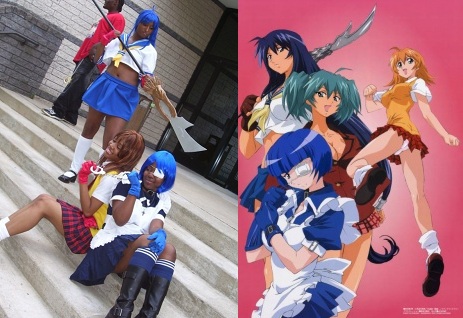
(Clockwise from top) An unknown cosplayer, HentaiGirl82, and Blikku cosplaying as Kanu Unchou, Ryomou Shimei, and Hakufu Sonsaku from "Ikki Tousen."

You see, as you might have seen on Community and its timeslot rival, The Big Bang Theory, whites aren’t the only cosplayers out there. Now apparently, this is a problem for some people – especially in anime fandom. I’ve heard many stories of snide comments made online and at conventions. It is supposedly because of the fact that most anime and video game characters are of a fair complexion that many people seem to think that people of color are unfit to cosplay anything but characters of color. While there are a good number of characters of color available and this site has a comprehensive list of many of them, though there are more that aren’t listed there, like:

  • Balrog/M.Bison from Street Fighter II
  • Barrett from Final Fantasy VII
  • Dudley from Street Fighter III
  • Elena from Street Fighter III
  • Jadakins from Tokyo Tribe 2
  • Kai Deguchi from Tokyo Tribe 2
  • Kaolla Su from Love Hina
  • Kevin Kotaro Abe from Whistle!
  • Mera from Tokyo Tribe 2
  • Octave from Interstella 5555: The 5tory of the 5ecret 5tar 5ystem
  • Takenori Akagi from Slam Dunk

My buddy, J Ryoga, as Tidus from "Final Fantasy X."

There are a few more, but I can’t remember the names. However, out of a few thousand anime titles, that still amounts to just under 200 names. Not only is it completely unreasonable to expect every darker-skinned person to stick to such a [relatively] short list of characters, but it’s absolutely ridiculous. Especially in a community where cross-playing is considered perfectly acceptable (Cross-playing is when a person of one sex cosplays as a character of the opposite sex). I should mention that I have absolutely no issue with cross-players, whether it’s a male cross-playing a female character or a female cross-playing a male character – just do it to the best of your ability. Cosplay is supposed to be about having fun and celebrating your favorite characters and/or series. If someone wears a good or bad cosplay, it shouldn’t matter if they’re black, white, fat, thin, male, or female. What matters is how the viewer likes the outfit. If you do, feel free to get a picture. If not, ignore it. If they’re not the same physical type as the character and they look amazing, praise them for doing so.

Any straight guys try to hit on this cosplayer, they're in for a shock - deviantArt's Manolo-kun crossplaying Utena Tenjou of "Revolutionary Girl Utena."

I find this whole behavior odd for a couple of reasons. Firstly, if you want to be technical about this whole issue, then outside of obvious European/non-Japanese characters like the Amestrans (eg: the Elrics, Roy Mustang, the Armstrong siblings, etc) of FullMetal Alchemist, Emma of Emma – A Victorian Romance, and Roger Smith of The Big O, there aren’t many “white” characters, either. Yes, there are far more than their darker-skinned counterparts, but the vast majority of fair-skinned characters in anime and manga are 100% Japanese born and raised. Even the majority of the characters who come to Japan from a foreign nation are of Japanese descent as well, but have simply returned to their home country (Minako Aino of Bishoujo Senshi Sailor Moon and Kanako Ohno of Genshiken are perfect examples of this). Therefore, according to their theories, they should not be cosplaying many of the characters they do.

The second reason I find this odd (and most importantly), is because if you’re involved in this activity, you’re more or less an outcast. Hopefully not literally in that you don’t have any friends at all, but an outcast in the fact that you don’t really have anywhere else to release this type of creativity. Perhaps you saw someone doing this in a movie or show and thought to yourself that this particular activity looked fun. Or maybe you’re a fan who was watching or reading a series and wanted to dress up as a particular character on Halloween, but just one day a year wasn’t enough. Point is, we’re all in this together. And when I say, “we’re all in this together,” I mean we’re all in this together.

(Clockwise from top) 'Chef' McElroy from "South Park," 'Might Suit' Naruto Uzumaki from "Naruto," 'Hunky no Jutsu' Temari from "Naruto," Kai Deguchi from "Tokyo Tribe 2" (Center) Eikichi Onizuka from "GTO: Great Teacher Onizuka"